Refreshed and expanded, July 29, 2026.
There is a small, angry boy in my head, still, who wanted to be an astronaut. He had the books, the plastic models, the star maps stuck to the ceiling above his bed in Torhout and the entire Apollo mission chronology memorized by age six. He was also colorblind. That is a spectacular way to have your career choice explained to you at fifteen by a school doctor with the bedside manner of a Belgian tax inspector and the tact of a red-light-district bouncer with chronic toothache. No astronaut track. No fighter pilot track. No submariner track. Any career involving a red light next to a green light was, effectively, closed on medical grounds.
So the boy did what small colorblind boys with unreasonable dreams have always done. He grew up, went into strategy (obviously), and started collecting watches designed for the exact people he was not allowed to become.
That is the whole collection. That is the whole thesis. Every piece on this list is a small, wearable protest against a pediatric ophthalmologist in the late 1970s. You can psychoanalyze me later. Bring Scottish, heavily peated whisky.
A note on how these things arrive on my wrist
Something you should know before we go any further: I have never bought a new watch. Not once. Not a single boutique-warm, price-tag-still-attached, plastic-still-on-the-caseback purchase in my life. Every watch here was traded, bargained for, hunted down on eBay, dragged out of an auction I probably should not have entered, or swapped with someone who wanted my old thing more than I wanted their old thing.
The journey to the watch matters more than the watch. Six months of low-grade obsession, four failed offers, one messenger conversation with a nervous seller in Milan, a discreet trip to a dealer in the Marolles (Brussels) who keeps interesting things in a shoebox behind the counter. That is the correct on-ramp. Walking into a boutique and pointing at a shiny (and overpriced) display case is the horological equivalent of buying an AI generated 3D poster of the Eiffel Tower in the gift shop. I try so hard not to be that person.
The watches below all earned their place by being hunted, not shopped. I remember the trade for every one of them. I remember what I gave up. I remember the seller. Sometimes I remember the seller’s cat. Cats matter.
What actually qualifies for the wrist
I am not (always) a bleating sheep. No Rolex crown parade, no polite Patek performance, no AP have-you-seen-what-I-can-afford cufflink energy of any kind. If you own a Datejust because you saw one on a hedge fund manager in a Zurich lounge, you and I are not in the same conversation. My filter is narrow, weirdly consistent, and non-negotiable.
Here is the whole rule. Big. Slightly techy. Serious with a sense of humor about itself. And, above all, tied to something the boy wanted: space, stars, aviation, the deep, adventure, a Cold War fantasy, or a piece of hardware someone actually used in anger. The watch has to hint at one of those worlds. Preferably several at once. If it does not hint at any of them, it does not make the drawer, no matter how much someone tells me it holds its value or how many successful sales managers have one.
There is a further filter. The piece has to make me smile on a bad Monday. If the answer to “does this cheer me up before espresso” is no, it goes. I have thinned the collection several times on that criterion alone. Boredom is the enemy. Life is short. Wrists are precious real estate (especially mine).
Breitling: pilots, adventurers, and the man who invented the chronograph pusher
A quick history detour, because Breitling deserves it. Léon Breitling opened his workshop in Saint-Imier in 1884, in the Jura mountains, and specialized from day one in chronographs and precision timers for science and industry. His son Gaston built the first wrist chronograph in 1915 and started strapping them to pilots, which sounds obvious now and was near-heretical then. His grandson Willy pushed the brand into aviation cockpits with onboard chronographs in the 1930s. Breitling did not stumble into aviation, it built aviation timekeeping while the rest of the industry was still perfecting elegant dress watches for gentlemen who never left their armchairs.
That is why I have four of them. Every Breitling on my wrist is doing 141 years of “we make instruments for people who go somewhere dangerous” as its opening argument. I am not going anywhere dangerous. That is not the point. The point is the argument.
Breitling Chronospace Military: stealth black, zero calories

Black carbon-coated steel, glare-proof sapphire, SuperQuartz movement ten times more accurate than the quartz in your microwave. Multi-city display, chronograph, alarm, countdown, second time zone, all of it packed into a case that looks like it should be smuggling documents through Moscow. I mostly use it to time how long I can avoid answering an emailer whose name I already forgot (which is, itself, a form of stealth).
It works. If a Navy SEAL and a strategic consultant collided at the wrist, this is what you would find in the wreckage. The consultant would be complaining, the watch would still be running.
Breitling Chronomat UTC: blue like the Emergency, obviously

Look at me. Look at my collection. What colour was always going to be my Chronomat? Correct. Breitling blue. The exact, correct blue. The same blue as my Emergency (we will get to that), because when I find a shade that works I commit to it like a religious position.
The Chronomat UTC has the second-time-zone dial built directly into the bracelet, sitting between the case and the strap, so you carry two watches on one wrist without noticing the extra weight. Genius bit of engineering, actually. Home time on the main dial, wherever-I-currently-am-pretending-to-live on the little bracelet dial, no juggling of crowns, no bezel arithmetic, no maths at 3am in a taxi in Doha.
This is my linen-suit-in-Casablanca watch. Handsome jet-lagged men nodding at Russian spies in dresses with strategic slits. Nobody wears linen suits any more, which is a tragedy, and Casablanca has fewer spies than it used to, which is either a tragedy or a triumph depending on your worldview. Either way, the watch remembers.
Dignity credits. Bad decisions. Balanced ledger.
Breitling Emergency: the beacon of my hypothetical Bear Grylls / Picard arc

The Breitling Emergency is a real thing. It has a certified 406 MHz distress transmitter with an antenna you unscrew from the case, and when activated it broadcasts an actual signal to actual COSPAS-SARSAT satellites, and actual rescue teams will actually come looking for you. Balloon adventurers have been pulled out of the Pacific with one. Fully functioning piece of aviation safety hardware disguised as a wristwatch.
Also, and I want to be clear about this, it is blue. The same blue as the Chronomat. UTC bezel. Because Breitling knows their audience and I am their audience. This is what committing to a colour looks like when it goes untreated for twenty years.
I promised my wife, on our wedding day, that with this watch she would find my hyena-gnawed bones before the vultures had finished the job. She said thank you. She said it flatly. I do not think she believed the hyenas were a real risk in East Flanders. She is possibly correct.
My use case for the Emergency is somewhere between Bear Grylls and Captain Jean-Luc Picard, and closer to Picard on most days. Less “eat a raw frog in a survival pit,” more “I would like a hot Earl Grey and a diplomatic solution, please, but if things escalate I have a functioning distress beacon on my left wrist.” Grown-up hero. Composed under pressure. Would rather negotiate than fight, but nonetheless quietly rescue-capable.
So far the most extreme place I have activated my Emergency is my imagination. The most muddy place I have taken it is a Norman forest in the Land Rover Defender, followed by an emergency stop for bread. The most crowded place is the endives queue at the local hypermarché, which is the last supermarket reference in this post.
But knowing I could summon a helicopter is, itself, a full-body posture correction. I stand straighter. I make eye contact with defiant pigeons. I am so prepared.
Breitling Avenger Blackbird 44: the covert one

All black. Every surface. Titanium case with a matte black carbon coating so light-absorbing you can lose it on a dark table. Black dial. Black hands, black indices, black bezel with just enough beige-cream lume that in daylight it looks almost decorative, and in the dark it looks like a very small runway on my wrist.
The Avenger line is Breitling’s military family, developed originally for pilots who needed instruments they could operate with gloves at altitude, in vibration, upside down, and possibly on fire. The Blackbird is the stealth variant of the Avenger, named (obviously) after the SR-71 reconnaissance aircraft that was so absurdly fast the standard procedure for a surface-to-air missile lock was “accelerate.” Mach 3.3, 85,000 feet, over Vietnam and the Soviet Union and everywhere else the CIA declined to comment on. The SR-71 was retired in 1998 and has never been replaced by anything faster, because nothing faster has ever been built.
I am not flying an SR-71. I am flying, badly, an Audi through Normandy roundabouts on the way to a business dinner. The watch does not judge me. It maintains stealth. It waits.
Mine came to me from an Italian dealer I met at Baselworld in a previous life. He wanted to move it because it “looked too aggressive” for his clientele in Milan, which is a sentence I still find funny. Aggressive for Milan. I swapped it on the spot. It has been my go-to travel piece ever since, because it goes with a black t-shirt in Berlin, a linen jacket in Marseille, and a wetsuit on the extremely rare occasion I accidentally end up in one.
Nubeo Apollo Automatic “One Small Step” NB-6132: I bought a piece of the Moon

Yes, I did. I own a fragment of the Moon. The Nubeo Apollo Automatic One Small Step Limited Edition is a 48mm slab of stainless steel, Japanese automatic movement, domed sapphire, 20 ATM water resistance, and a raised three-dimensional footprint bezel that lets you run your thumb across the tread of humanity’s first step on another world. My thumb has done this many times.
But the caseback is where the argument is won. Individually numbered. Engraved with Neil Armstrong’s line and the exact timestamp (10:56 PM ET, July 20, 1969). And set into the caseback is a genuine sliver of lunar meteorite, Northwest Africa 7959, which was blasted off the Moon by an impact millions of years ago, drifted through space, fell into the Sahara, and was recovered by a nomad with better geology skills than most PhDs. That specific chunk of rock is older than every civilization that ever tried to invade Belgium, and every civilization that ever tried to invade Belgium is a long list.
Limited to 500 pieces worldwide, 100 per variant. Mine came through a trade with a collector in the Netherlands who wanted something with a Swiss lever escapement more than he wanted a Moon. I found this transaction morally satisfying on both sides. He wanted horology. I wanted geology. We both went home happy.
Is 48mm too large for my wrist? Absolutely. Do I care? I own a fragment of the Moon. The colorblind boy from Aalter would like to say something at this point, but he is speechless. He is also, quietly and privately, ecstatic, because he has spent forty years reading Apollo mission transcripts, and now a chip of the actual thing lives on his wrist, and no one gets to take that away from him.
U-BOAT 1001: an Italian navy watch that got out of the drawer 58 years late

Time for U-Boat, and time for one of my favourite watch-brand origin stories, because this one has the mid-century Italian engineering plot twist that watch marketing usually invents but in this case appears to be broadly true.
In 1942, an engineer named Ilvo Fontana, working in Lucca, received a commission from the Italian Navy: design a bomb-proof, waterproof, shockproof, high-legibility wristwatch for pilots and submariners. He did the drawings. He solved the crown-on-the-left problem (so pilots and divers with gloves could still operate it). He nailed the oversized case for legibility in low light. Then the war ended, the commission evaporated, the drawings went into a drawer, and Ilvo went back to his precision engineering business without ever making the watch.
Fast forward almost sixty years. In 2000, Ilvo’s grandson Italo Fontana finds the drawings, and reasonably concludes: this is a business plan. Seven years of prototype work later, U-Boat launches. Same crown-on-the-left. Same oversized case. Same Tuscan-artisan swagger. Every U-Boat you see today is essentially a piece of Italian military hardware that missed its war and had to wait for a peacetime market. There is something delightful about that.
Mine is the U-1001. Water resistant to a completely unhinged 1.001 metres. I once got a leg cramp in the shallow end of a public pool in Ghent. There is a mismatch between the watch and the wrist. I do not care.
The case is enormous. The crown guard alone would break a knuckle in a bar fight. When I wear it I feel like I could arm-wrestle a squid. The closest I have come to a squid recently was the fritto misto at a place in Portofino, and even that squid had a better dive log than I do. I keep the U-1001 anyway, because 90% of the work is done by the idea of the watch, and the idea of the watch is a magnificent idea. Grandpa Ilvo drew this thing for the Regia Marina. I wear it while missing a Teams call. Continuity of dreams.
Bulova Computron: my parents’ idea of the future, running on my wrist

The Bulova Computron. Angular case, red LED, wristworn Starfleet officer energy, permanently five minutes away from being beamed up by Scotty. A monument to the future our parents’ generation was promised and never received. Flying cars, moon colonies, watches that talk. We got two out of three, which is not bad, though the flying cars were still late.
Every time I press the button and the red digits blink to life, I remember that in 1976 someone thought this was the height of elegance. They were right.
Mine came from a Belgian collector who was clearing out his 1970s stash and needed cash for a Universal Genève. We haggled for an hour over drinks in Antwerp. He told me his father had worn the same reference when he worked at Sabena. That story is now the caseback of the watch as far as I am concerned. Provenance is 40% story, 60% paperwork, and I will happily do without the paperwork.
CIGA Design Eye of Horus: the one that carries my logo

I was a very early backer of the CIGA Design Eye of Horus. Not a “day one” backer in the mild social-media sense. A “wrote the founder a series of increasingly enthusiastic emails” backer. Ended up with a piece that carries my personal logo on the caseback, which is either the most flattering thing that has ever happened to a strategic consultant or a sign that I need supervised hobbies.
Carbon fibre construction, skeleton dial that lets you stare into the movement like an aquarium of small suicidal Swiss decisions. Part horology, part mechanical art exhibit, part small monument to me having a genuinely excellent time on Kickstarter one particular evening in 2018. It is the watch I bring out when someone at dinner asks, “so what do you actually do?” and I need a prop.
Russian Sturmanskie: strapped to Gagarin, strapped to me, spiritually

On 12 April 1961, a 27-year-old Soviet air-force lieutenant named Yuri Gagarin climbed into Vostok 1, orbited the Earth once at 27.400 kilometres per hour, and became the first human being to punch above the atmosphere. On his left wrist was a Sturmanskie, standard Soviet military-issue navigator’s watch, black dial, 33mm case, hand-wound, quite ordinary except for having been very extraordinarily above every human that has ever lived.
Mine is not that specific one (I hope this clarification is useful). Mine is the same reference: sturdy, unfussy, Cold War-in-a-small-case. Wearing it feels like sneaking a piece of Soviet space propaganda past customs. Handwound. Solid steel. Least dramatic watch in the drawer. By some distance the most historically loaded. The colorblind boy from Aalter thinks this is the coolest object he has ever seen, and the fifty-(something)-year-old man wearing it agrees.
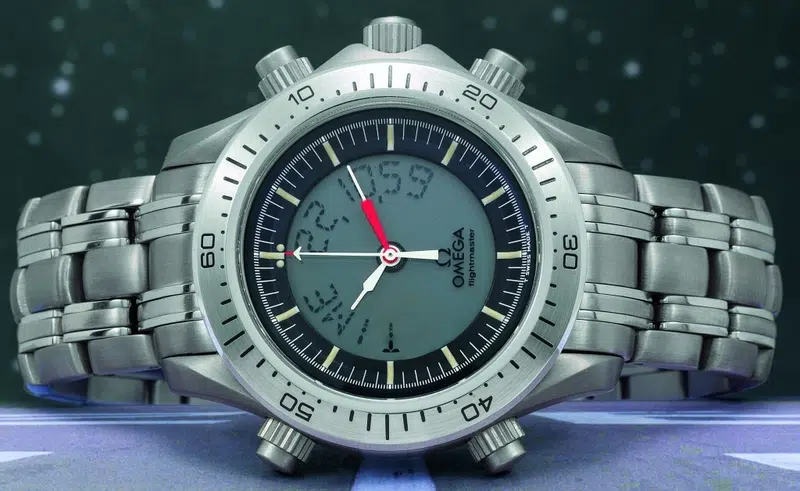
Omega X-33: the Marswatch, the resistance piece, the reason for the whole shelf

Now we come to the centre of gravity. The Omega X-33 is not an ordinary Omega. Omega has been in space since 1965, when the Speedmaster passed NASA’s brutal qualification tests and was certified as “flight qualified for all manned space missions.” That is the Moonwatch story, and the Speedmaster is rightly famous. It went to the Moon, it saved Apollo 13 (three astronauts, one manually-timed 14-second engine burn on the Speedmaster, the difference between coming home and drifting off into the dark), and it earned NASA’s Silver Snoopy Award in 1970 for that specific rescue. Excellent watch. Not what we are talking about here.
The X-33 is the other one. The digital-analog hybrid Omega developed in the 1990s in collaboration with actual astronauts, including General Tom Stafford, an Apollo veteran who had opinions about what a real space watch needed. It was designed around the NASA X-33 program, a proposed reusable single-stage-to-orbit launch vehicle that would have replaced the Space Shuttle. Ambitious. Beautiful. Cancelled in 2001 because rocket science, it turns out, is hard and expensive. But the watch had already been built, already been sent to the Russian MIR space station for real-environment testing, and already been certified for spaceflight. And it had a nickname the astronauts started using themselves: the Marswatch. Because the ambition, honestly, was Mars.
The program died. The watch lived. It got quietly rebranded as the “Starwalker” for a while (a name so weak I refuse to acknowledge it), but to me and to the small colorblind boy in my head, it will always be the Marswatch.
What does it actually do? Everything. Mission Elapsed Time. Phase Elapsed Time. Perpetual calendar. Solar compass. Three time zones. Three separate alarms, each hitting 80 decibels, enough to reanimate a hibernating astronaut or, more realistically, to warn me that my espresso is done and my toast is burning. UTC. Chronograph. Countdown. All of it in a titanium case that weighs almost nothing, because titanium was the compromise you made with astronauts who could not spare a gram on ascent.
Certified for space. This is not marketing. It is certified. For. Space.
I did not buy this watch. Nobody buys a Marswatch. You trade for a Marswatch. I gave up an old Yema and a very funky RSW to a Swedish collector who was, and I mean this affectionately, wrong about what he wanted. He wanted vintage funkiness. I wanted certified-for-space. We were both correct at the same time, which is the platonic ideal of a trade.
It has functions I will never use, in scenarios I will never be in. The gap between what the watch is capable of and what my life demands of it is precisely what I love. It is a promise I made to the boy, and the boy has accepted the promise.
Panerai: manhole covers with luminescent numerals, and I own three
And now, the other Italians. A brief history, because Panerai’s origin story is genuinely operatic and I refuse to summarize it in one sentence.
Giovanni Panerai opened his watchmaking workshop in Florence in 1860. Panerai became the official supplier of high-precision instruments to the Regia Marina, the Royal Italian Navy. In 1916 they patented a radium-based luminous compound called Radiomir, which glowed intensely enough to be read through a diving mask in dark water. Not luminescent enough. Absurdly luminescent. Glow-in-the-dark by way of “please do not point that at me for extended periods.”
In 1936, Panerai delivered the first ten prototype dive watches for the frogmen of the Decima Flottiglia MAS, the Italian Navy’s elite underwater combat unit, the men who rode “slow-speed torpedoes” (they nicknamed them “pigs”) through Allied harbours in World War II and blew up battleships in Alexandria and Gibraltar.
The watch they wore was reference 2533, a 47mm cushion-shaped steel case, wire lugs, and a dial so bright a commando underwater in the pitch dark could still see it. Panerai kept the reference for the Navy only, and did not sell to civilians until the 1990s, when Sylvester Stallone spotted one in a Roman shop window and effectively singlehandedly turned it into a global cult brand. The rest is Vendôme and Richemont and Officine and Neuchâtel and 5000-euro price tags. But underneath all that, every Panerai I own is still, at heart, a Regia Marina frogman tool.
I now own three. This is either a phase or a diagnosis. Time will tell. Also, and I want to be clear about attribution: this is Josselin’s fault. He owns one. His is magnificent. I saw it on his wrist over a lunch in Paris that I remember mainly for the wine, the fascinating talk and the watch, and something in me quietly reorganized its priorities that afternoon. If you are reading this, Josselin, thank you and also I blame you.
Panerai Luminor Marina PAM 00111: the honest classic

The PAM 111 is the reference every Panerai obsessive owns and pretends not to obsess over. Steel, 44mm cushion case, sandwich dial (two layers of dial with lume packed between, another Panerai trademark), small seconds at nine o’clock, manual-wind Panerai OP XI calibre with a 56-hour reserve, COSC chronometer, 300 metres water resistant. It is the gateway Panerai. Once you wear the 111, you understand the whole language of the brand, and you also understand why the language is dangerous.
If you can wear the 111 without smirking at your own reflection, you are a stronger human being than I am. I still smirk.
Mine came out of a private sale in Antwerp, from a man who had inherited it from his father and wanted a smaller watch (a fatal error, but his to make. The trade took three months of casual weekend messages. I ran mine on both the brown vintage leather strap and a military green rubber one, depending on whether I want to look like a Fiat 500 parked in Portofino or a paratrooper who wandered into a wine bar. Both moods are valid. Both moods are load-bearing.
Panerai Luminor Marina New York Boutique PAM 00417: 150 pieces, one Statue of Liberty

Released in 2010 to celebrate the New York Panerai boutique, limited to 150 units worldwide, closed steel caseback engraved with the Statue of Liberty. It is, on paper, an absurd object: a Florentine watch, made for an Italian navy heritage story, produced in a limited run to celebrate a boutique in Manhattan. Every part of that sentence is fighting every other part.
On the wrist it makes perfect sense, which tells you everything you need to know about how the mind rearranges itself under sufficient Panerai exposure.
Same OP II calibre, same 44mm cushion case, sapphire crystal, 300 metres water resistant. It feels heavier than the 111, though the specs say it should not. Watches have moods too, and this one is New York in October: sharp, slightly arrogant, better with a wool coat.
I found mine through an Eastern European Panerai enthusiast who needed to make room for new projects. Careful photographs, a long messenger thread, a shared and slightly worrying depth of knowledge about the 2010 boutique editions, and eventually a trade price we both pretended was reasonable. Panerai people always know exactly how many pieces were made, in what year, and which caseback engraving belongs to which store. It is a small parallel civilization. I am now, apparently, a citizen.
Panerai Luminor Submersible 1950 Carbotech PAM 00616: the black wafer, the reference piece, the Tony Stark watch

Right. Sit down. Deep breath. We need to talk about the 616. Panerai launched the Luminor Submersible 1950 Carbotech at SIHH 2015 and did something no other watch brand had ever done: they built the case, the bezel, and the crown-guard lever out of Carbotech, a proprietary composite of carbon-fibre sheets bonded under high pressure and heat with PEEK polymer (polyether ether ketone, the same industrial polymer used in aerospace and orthopaedic implants). Each block of Carbotech is unique, because the fibres arrange themselves however they like during the pressing process, which means no two 616s look exactly the same. Every one has its own grain pattern, like fingerprints for divers.
Lighter than titanium. Tougher than ceramic. Non-corrosive. Hypoallergenic, in case your wrist has strong opinions. Rated to 300 metres. 47mm case. 4mm sapphire crystal. In-house automatic P.9000 calibre, twin barrels, 72-hour power reserve, 197 components, 28 jewels, 28.800 vph. Titanium caseback with DLC, engraved with “Florence 1860” and the outline of a slow-speed torpedo. That torpedo engraving is a direct link back to Decima MAS. Every 616 wearer is, in some very small way, wearing a piece of the Regia Marina frogman legacy on their wrist. It is deeply serious and completely absurd at the same time, which is my favourite emotional register.
Vintage-cream lume on the numerals and hands. Small pops of Panerai blue on the seconds subdial at nine. Black rubber strap with the OP logo picked out in blue.
This watch does not shout. It does not need to. It is the quietest weapon in the drawer, and it is confident about it.
Also, and I say this as objective sartorial fact: Tony Stark wore a Panerai Luminor Submersible in the Marvel films, and Dwayne “The Rock” Johnson wears Panerai Submersibles as his default watch on and off the Rock’s massive wrists. Iron Man and the Rock. Iron Man, the Rock, and me. That is the wearer roster. I am the smallest wrist in that lineup by roughly 40%, but I am on it.
I traded my way to this one over eighteen months, through three different intermediate pieces, one of which was a Bell & Ross that I never really liked but was strategically useful. The 616 is now the piece I reach for when I want the wrist to look like a piece of stealth naval hardware got lost on the way to a mission.
Interim conclusions from a wrist that has too many opinions
The collection is now roughly split three ways, and looking at it, the pattern is unmissable.
Aviation Breitlings for the pilot the doctor said I could not become. Space watches (Omega X-33, Nubeo Apollo, Sturmanskie) for the astronaut the doctor definitely said I could not become. Panerai for the Italian navy frogman I would have made a spectacularly bad candidate for on multiple grounds, but that has never stopped anyone from wanting the watch.
Every single piece here is an argument with an ophthalmologist who is almost certainly no longer alive. That does not, in any way, make me want to stop making the argument.
I have no coherent thesis. Each of these objects earned its spot with a story, an argument, a trade, or a specific evening when I clicked “buy” on eBay and my wife pretended not to notice the DHL truck.
So, next?
I already know. It has to be one of two things.
First candidate: the newer Omega Speedmaster Dark Side of the Moon Apollo 8. Full ceramic case in matte black zirconium-dioxide, launched to mark the fiftieth anniversary of Apollo 8, the first crewed mission to leave low Earth orbit, circle the Moon, and see its far side with human eyes: Borman, Lovell, Anders, Christmas Eve 1968, reading Genesis on a live broadcast to the largest television audience in history to that point. The dial is a laser-ablated moonscape, hand-finished, with a tiny sub-second at 9 that shows a decorated view of the Moon’s far side and a caseback engraved with the same. Black on black on black on lunar topography.
It is, for a colorblind boy, extremely on-brand: a watch with essentially two colours, both of which I can see perfectly. Take that, doctor.
Second candidate: an Omega Speedmaster Silver Snoopy Award edition. Because in 1970, after the Speedmaster helped bring Apollo 13 home with that impossible 14-second manually-timed engine burn, NASA awarded Omega the Silver Snoopy pin, one of the highest honors in the American space programme, given to companies whose work contributed to the safety of astronauts. Snoopy on the caseback. Snoopy on the subdial. A cartoon beagle in a spacesuit that is also a full, formal NASA award. There is a small colorblind boy in my head who thinks that is the funniest and most beautiful thing a watch can be, and I am inclined to agree with him.
I will not “buy” either. I will hunt one. I will trade for it. I will over-bid on principle against someone I disapprove of.
Until then, I will keep timing my espresso in three time zones with the certified-for-space Marswatch, activating my imagination on the Emergency, arm-wrestling imaginary squids with the U-Boat, wearing the Panerai 616 like a small piece of Regia Marina hardware got lost on the way to a mission, and pretending my Blackbird is on covert assignment somewhere over the Ardennes.
Buzz Lightyear was right.
The doctor was wrong.
More on this pillar: 100,000 Miles is the rolling sourcing project this writing belongs to.