Musk’s SpaceX xAI just left Earth’s zip code
February 2, 2026. I was quietly having my last double espresso of the day, when Elon Musk announced that SpaceX has acquired xAI. That made me grab another cookie. The word “merger” feels way too small (and earthly) for what’s being implied. The combined valuation of his two brain darlings sits roughly around $1.25 trillion, with SpaceX at about $1 trillion and xAI at about $250 billion.
The internet did its usual foam-at-the-mouth cardio within minutes. The safe headline appeared everywhere: “Musk consolidates.” Sure. That’s the Wikipedia summary, and it kinda misses the point entirely. The more interesting version sits giggling inside the technical thesis, riding shotgun with the deal: as AI compute keeps expanding, needing more and more data centers… power and cooling keep becoming political. Elon Musk is notoriously allergic to red tape, restrictions, (common sense) and annoying save-the-earth-we-need-water blablah. He is clearly bored of fighting terrestrial constraints with terrestrial compromises. He is upset with everything that slows down his imperial vision. So his ambition drifts upward, where permits are different, neighbors are absent, and the Sun does what it has always done without scheduling a stakeholder workshop or causing a ESG fit.
A few days earlier, SpaceX filed with the FCC to request authority for up to one million (!) satellites in earths orbit, roughly ranging between 500 and 2.000 km. The filing explicitly framed the satellites as solar-powered infrastructure for on-orbit processing. The filing itself leans into a familiar SpaceX rhetorical move: say a number that makes you blink, then quietly remind everyone that satellite operators often ask for more than they plan to deploy because “flexibility”, and because the current reality in orbit is still tiny by comparison. We are at roughly 15.000 satellites today, and SpaceX itself at roughly 9.500 for Starlink.
One million satellites is the kind of figure that makes rational people reach for a calculator and irrational people reach for a valuation model. It also helps to understand the scale Musk is gesturing at. The filings and the surrounding commentary paint a picture of orbit as a distributed data center plane: solar input, optical links, compute payloads, results beamed down. A future where the lowest cost “total AI compute” migrates off-world. The filing explicitly argues that fully reusable launch vehicles “can deploy millions of tons of mass per year to orbit when launching at rate”, making on-orbit processing capacity scalable in a way that starts to compete with terrestrial buildouts.

Kessler Syndrome: space does compound interest too
The science-fiction fan in me feels morally obliged to pause and admire the pure audacity. The adult in me, the father, the person who still believes the universe punishes hubris for sport, hears “one million satellites” and immediately sees a dystopian traffic jam in the sky.
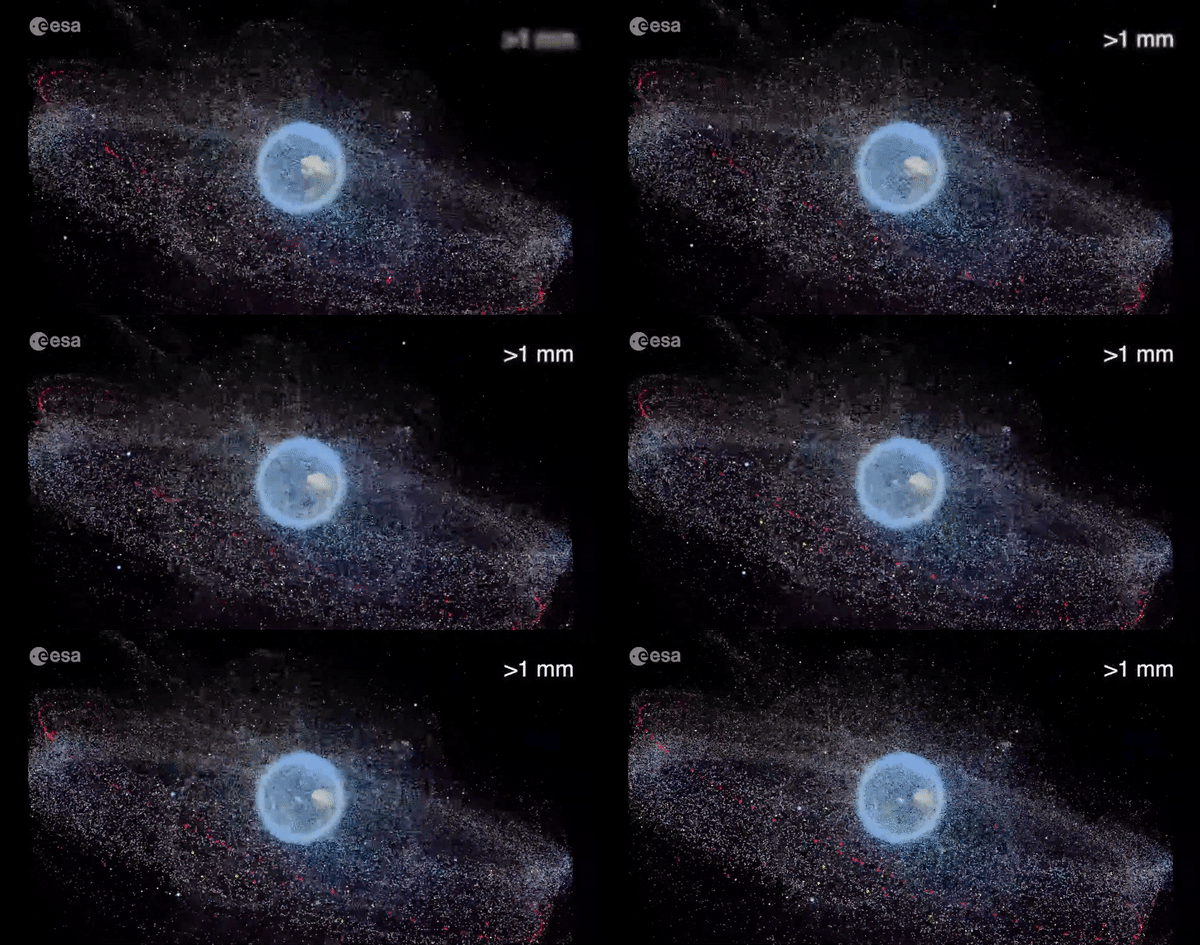
A million satellites drags a very unpoetic concept into the conversation: the Kessler Syndrome. It’s the debris nightmare scenario space engineers have been warning about since the 1970s: orbital traffic reaches a kind of critical density and collisions stop being rare accidents and start behaving like compound interest. One smash creates a shrapnel cloud, that cloud creates more smashes, those create more clouds, and before long you’re running a roulette wheel where every new fragment increases the odds of the next impact. NASA’s own debris notes describe the tipping point bluntly: once collisional cascading begins, the risk climbs until an orbit can become effectively unusable. ESA frames it similarly: pass a “critical mass” and the total debris population keeps growing because collisions breed collisions, in a chain reaction. Which is why “one million satellites” is an engineering and logistic flex; but also a governance and hygiene problem. Space has no street sweepers. Space doesn’t do tow trucks. Space does kaboom, a lot.
The other numbers people are circulating are also intentionally provocative. Coverage of the filing and related chatter points to a rough yardstick SpaceX used in its narrative: 100 kW of compute per ton, scaled to the idea of a million tons yielding a mindboggling 100 gigawatts of compute. Someone is really trying to redraw the boundaries.
Money always reveals the urgency hiding behind the poetry: xAI announced it raised an upsized $20 billion Series E in early January, with Qatar Investment Authority among the named investors. It also has a financial profile that looks exactly like what happens when you decide to play the frontier game at neckbreaking speed. Le Monde reports xAI burning lazily around $1 billion per month, while SpaceX is presented as the profitable adult in the room, reportedly making around $8 billion profit in 2025. Reuters, separately, has reported internal-document-driven signals of widening losses at xAI, with Bloomberg News cited around a $1.46 billion quarterly net loss in late 2025.
So the merger has the unmistakable gunpowder smell of financial gravity: xAI gets access to SpaceX’s balance sheet and its credibility, and SpaceX gets a narrative that turns “we launch rockets and sell satellite internet” into “we are building the physical backbone of the next compute era.” That storyline matters even more with IPO talk floating around, including reporting that SpaceX is exploring a 2026 listing around June-isch that could push valuation beyond $1.5 trillion. Not bad for a rocket-rookie.
It also matters because this is not Musk’s first consolidation tango. In March 2025, xAI acquired X (formerly Twitter) for $33 billion in an all-stock deal, bundling Grok distribution and a giant real-time data stream into the same machine.
Stack those moves and you get Elon’s wettest dream: X. The vertical integration diagram people keep drawing on napkins at dinner parties: rockets, satellites, connectivity, social data, models, distribution, and now an explicitly stated intention to push AI data centers into orbit.
But, hold your horses, it’s not as simple as that. Trillionaire or not. On-orbit compute sounds clean until you remember what space does to electronics. Radiation isn’t a metaphor up there. It’s flesh and metal scorching reality. Single-event effects are a whole discipline. NASA has been publishing on mitigation and system-level planning for decades, and the punchline stays brutally consistent: resilience gets designed in, because “operational fixes” are hard (and very very costly) when your server rack is doing 7.8 km/s over the Pacific in a cloud of nano debris.
That forces architectural choices hyperscalers don’t love: hardened components, redundancy everywhere, constant verification, error correction that feels like overhead until the first cosmic ray flips the wrong bit at the wrong time, or cosmic dust spears a NVIDEA chip.
Thermal is the other quiet assassin. Terrestrial data centers do their (very) ugly work with convection, water loops, and industrial-scale plumbing. Space takes those handy and cheap toys away. Heat has to leave by radiation, which means a lot of exposed radiator surface area and careful geometry, plus a constant balancing act between the surfaces that want sunlight (power) and the surfaces that want darkness (cooling). People can wave their hands about “vacuum cooling”; the engineering reality is radiator sizing and waste-heat math, and you don’t get to negotiate with Stefan–Boltzmann.
Even if those two problems get solved elegantly, economics remains the part that refuses to be impressed by Elon’s charisma. There are attempts to model orbital-vs-terrestrial cost-per-watt, and they tend to land in the same uncomfortable zone: space can be physically possible and economically savage at the same time. One recent calculator-style analysis frames orbital cost-per-watt as materially higher than terrestrial baselines, with launch and satellite capex dominating the story. SpaceX, of course, has a cultural allergy to the words “dominates the story,” which is why the whole plan leans so heavily on Starship and reusability, because reusability is the only lever big enough to move the economics without prayer.

Starship as forklift
Starship is still in that very awkward phase where believers see inevitability and skeptics see a lot of (spectacular) fire. 11 Starship test launches since 2023, with Musk expecting it to put its first payloads into orbit this year. The hinge on which this entire orbital data center thesis swings is still being very much machined. If Starship becomes routine, cadence becomes the new battlefield. If cadence becomes the new battlefield, “one million satellites” stops sounding like a sci-fi throwaway and starts sounding like a supply chain question with spreadsheets, range approvals, tank farms, refurbishment cycles, and the kind of operational discipline most companies only discover after their third major crisis.
The story gets morally itchy: xAI’s Earth-side footprint doesn’t exactly radiate “trust us, we’ll be responsible.” Colossus is xAI’s flagship supercomputer and data-center buildout in Memphis, the one built at warp speed to train Grok and feed the whole X machine, and it has already become a local fight about power, air, and who gets to pay the real cost of “move fast.” Dozens of methane gas turbines were brought in to keep the site running. An U.S. Environmental Protection Agency positions that those turbines require air permits even when treated as portable or temporary. The site is drawing roughly 150 MW at full capacity. Wow. That’s a lot of electricity, a lot of emissions, and a lot of people nearby who never volunteered to become collateral in a compute race.
When the same ecosystem that fought a year and a half over truck-sized methane turbines starts bitching and pitching orbit as the environmentally gentler alternative, you can see why some people hear “innovation” and others hear “regulatory geography.” Orbit has no local county loopholes. Orbit has different loopholes. It also has a habit of making externalities harder to see until they become unavoidable.
Grok: the reputational hitchhiker
Grok adds another layer of complication, because it drags SpaceX into a category of scrutiny SpaceX has historically avoided. The UK’s Information Commissioner’s Office launched a formal investigation into Grok over personal data processing and the creation of harmful sexualised imagery, with Ofcom pursuing its own track around platform duties. That is the kind of reputational baggage at the worst possible moment, particularly when IPO dreams demand “boring, governable, institution-friendly.”
Meanwhile the competitive landscape is getting crowded fast, which is how you know the underlying constraint is real. Jeff Bezos’ Blue Origin is working on orbital data center technology, with Bezos on record predicting gigawatt-scale data centers in space within 10 to 20 years, powered by continuous solar availability without weather. There is a broader field forming around the idea: Starcloud backed by Nvidia activity, Google’s “Project Suncatcher”, and even national-level programs. China’s space industrial plan explicitly namechecks space-based AI data centers on a five-year timeline, aiming at a “Space Cloud” by 2030, and it reads like a direct answer to Musk’s provocation.
So it is not only a Musk story. It’s an infrastructure story. AI has turned electricity, cooling, and throughput into strategic assets. Earth grids move at the speed of politics and concrete. Training runs move at the speed of competitive fear. Everyone feels the mismatch. Some people respond by building in colder places. Others respond by buying nuclear. Musk responds by trying to industrialize orbit, then wrapping it inside the single corporate entity most capable of making the attempt plausible.
The boring nouns win
Does the million-satellite vision happen on the timeline implied by the hype? I’d bet my watch collection against it, and I like my watches too much to be generous. (He never delivers on time, nor budget). A more believable arc looks like this: smaller proof-of-concepts, orbit-hosted workloads that make immediate sense for satellite networks, gradual expansion as launch and hardware economics get less cruel, and a slow migration of specific compute categories upward, guided by constraints rather than ideology. I see it as a 2030 story (ok, that’s tomorrow).
Musk will keep seasoning it with cosmic language about “extending consciousness” because that’s part of his brand: engineering, empire, myth, all braided together so tightly you can’t tug one without pulling the others. The irony is that the most profound part of this story is also the most mundane.
Power. Heat. Scale. Logistics. Governance.
All the boring nouns that end up deciding the future, while the rest of us still argue about the exciting adjectives.