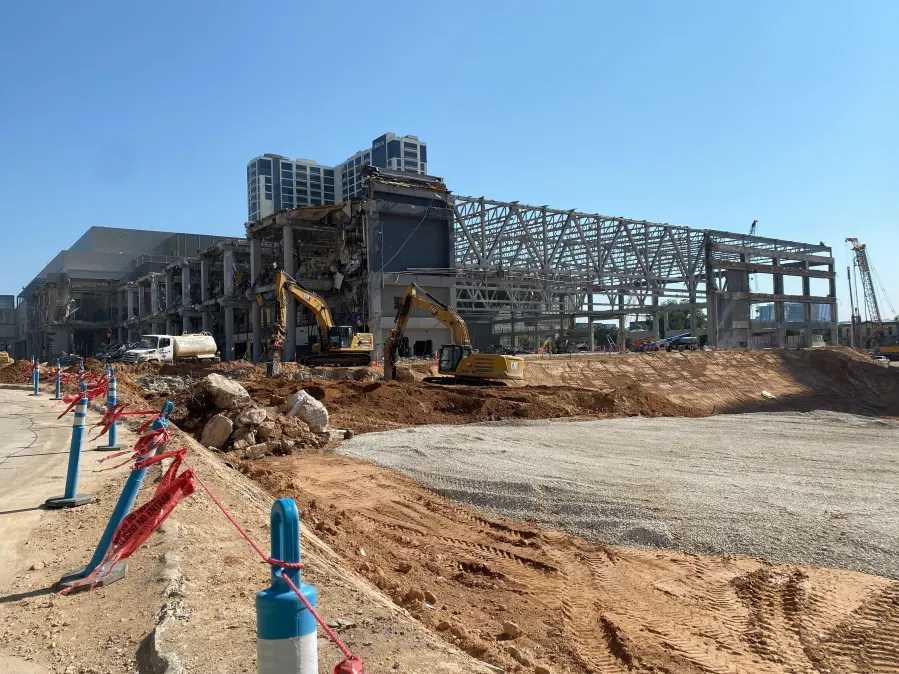
It’s 40 years old, and for the first time it has no home. No big concrete box on César Chávez to anchor the madness. The Austin Convention Center, that brutalist mothership where every badge-wearing soul eventually collided with every other badge-wearing soul is rubble. A $1.6 billion hole in the ground with a (very questionable) 2029 delivery date. And yet here I am, SXSW 2026, day one, with downtown Austin turned into a pop-up village of hotel ballrooms, music halls, and three so-called “Clubhouses” that are supposed to replace a building the size of a small European airport.
The Innovation Clubhouse at Brazos Hall. Film & TV at 800 Congress. Music at The Downright in the Red River district, shuttle busses connecting them like a creepy slow nervous system. The whole thing feels like a festival that just woke up in a new apartment and can’t find the coffee maker. And yet –and yet– there’s already an energy here that the old format had started to lose. People are walking (a lot 😊). People are bumping into strangers from different tracks. The filmmaker is overhearing the AI panel. The startup founder is wandering into a music showcase. The accidental cross-pollination that made SXSW legendary in the first place, that I loved in the early days? It might be back, precisely because the organizers were forced to blow up the old blueprint.
The question everyone is asking, in every lobby, at every taco stand, in every Slack channel buzzing with remote attendees: will this decentralized thing actually work?
Why this congress still matters
I’ve been coming here every single year since the days when foursquare was declared an instant winner by the social media savvy crowd in Austin, when five startups a day would pitch you in the bloggers’ lounge, and only one in a hundred would survive the next 300 days. The graveyard of SXSW ideas is enormous and mostly silent. For every Twitter that made it out alive, there are hundreds of ghost apps whose founders went home, burned through the last of their savings, and quietly folded.
But here’s the thing: the ones that did survive changed the world… a bit, or a lot. Twitter launched here in 2007 and went from 20,000 to 60,000 tweets a day in a matter of Austin hours. Foursquare rode out of SXSW 2009 and redefined location-based services. Meerkat blew up in 2015 and – even though it died on stage- it forced Facebook and Twitter to build live-streaming, which is now infrastructure. Uber and Lyft started operating in Austin during SXSW 2010 and rewired urban transportation globally. The Butterfly iQ portable ultrasound, Aflac’s robotic companion duck for kids with cancer, Siri’s early showcase, countless AI tools that are now in your phone… all of them passed through this particular sieve.
SXSW is not a trade fair. It is not CES. It is not Davos with breakfast tacos. It is the one place where an idea gets thrown into a crowd of 100,000 brutally curious, slightly drunk, massively sleep-deprived humans from every imaginable discipline, and either catches fire or evaporates in the Texas heat. Quarter neither asked nor given. That mechanism – chaotic, unfair, glorious-still works. It might be the only reliable early warning system the tech-culture complex has.
2026: AI, truth, and the machines we’ve become
This year’s programming is among the most intense I’ve seen. The opening day alone is stacked: a panel called As We Embrace AI, Let’s Not Forget Our Minds, with MIT’s Sanjay Sarma and others, asking the uncomfortable question no one in Silicon Valley wants to hear: are we getting dumber as our tools get smarter? On the same day, journalist Tara Palmeri sits down with Imran Ahmed of the Center for Countering Digital Hate to dissect who actually owns the truth when algorithms, AI, and a shattered media landscape are doing the editing… and not always in the smartest of ways.
Later in the week, I ‘ll see Cloudflare’s Matthew Prince tackle what might be the scariest topic for media people on the entire schedule: The Internet After Search. The economic model that sustained the web for three decades -you make content, search drives traffic, traffic earns revenue- is collapsing. AI now answers questions directly. Agents complete transactions without visiting a single website. Content creators are bleeding traffic and income with no fix in sight. If you make things for the internet and you’re not paying attention to this session, you’re asleep at the wheel.
Futurist Amy Webb will once again launch her annual Emerging Tech Trend Report. her keynote is consistently one of the most attended sessions for good reason. Last year she warned us about Living Intelligence, the fusion of AI and biotech that she says we are not remotely prepared for. This year promises to be stranger and closer than we imagine. Garry Tan from Y Combinator co-emcees SXSW Pitch, where 730+ alumni companies have collectively raised over $22 billion. The old Austin Convention Center is gone, but the deal-making machinery is very much alive.
The decentralized bet
Here is what fascinates me most before I dive into ths first congress day: the format is the story. The absence of a central hub has accidentally created a live experiment in exactly the kind of thinking the tech world has been debating for years. Decentralize. Distribute. Trust the nodes instead of the center.
SXSW 2026 is all about decentralization this year… it’s living it. Programming tracks aligned with key buildings across downtown. Three clubhouses instead of one mothership. More venues, more walking, more randomness, more serendipity. The festival has been compressed from a sprawling two-weekend affair into a single seven-day sprint. Everything overlaps: tech panels run alongside film premieres and music showcases from day one.
The skeptics have a point: fragmentation is a risk. Fewer sponsors, smaller footprints, no single gravity well where everyone meets. Some worry (and I disagree) that the magic was always in the density, and you can’t replicate density across a dozen hotels. But the optimists -and I count myself among them-, cautiously, with both eyebrows raised, see something else: a festival that was forced to reinvent itself and might have stumbled into a better version. A more human-scale, walkable, accidental format where you discover things because you got lost, not because an algorithm put it on your schedule.
Whether it works won’t be clear until Sunday, maybe not until next year.
I’m diving in now. Keynotes, panels, hallway conversations, taco-fueled debates, the occasional existential crisis about whether AI is saving us or eating us alive. The stream of ideas starts today and I fully intend to swim in it, drown in it a little, and report back from whatever shore I wash up on.
Day one. Let’s see what survives…