I wanted to be an astronaut. Badly. Not in the “I had a poster on my wall” way. In the “I was already mentally picking out the color of my NASA flight suit” way. While other kids were deciding between lawyer, doctor, police officer or rock star, I had a very precise five‑step plan involving physics, test pilot school, a T-38 coverall with space patches and a calm, confident “Copy that, Houston.”
Then, at sixteen, reality walked in, dressed in a white coat and carrying an absolute nightmare of pastel colored dots. The ophthalmologist smiled, handed me one of those cursed Ishihara plates – the ones that look like a plate of Smarties had a nervous breakdown – and asked: “What number do you see?” I squinted. Tilted my head. Blinked. Tried from a different angle, as if colorblindness was a drunken Wi‑Fi signal that might be stronger by the window. “Euh… six?”
She nodded, slowly, then showed me the next plate. By number four, it was painfully clear: whatever I was seeing, it wasn’t what the rest of the planet was seeing. By number eight, my childhood dream had the structural integrity of a Soyuz after a budget cut. “Good news,” she said, “you see very well.” “Bad news?” I asked (my parents trained me well). “You’re colorblind.” Not “a little.” Not “mildly.” Colorblind the size of an ugly fluo yellow school bus. Goodbye, astronaut program. Hello, grayscale life. No more reaching for the skies or rocketing for the stars.
Or so I thought.
From failed astronaut to horological weirdo
When the space agencies quietly stop returning your calls (apparently “can’t tell red from green” is frowned upon in a spacecraft cockpit), you have two options: become bitter, or become utterly weird. I chose weird, still do. If I couldn’t go to space, I was damn well going to wear it on my wrist. What followed has already been documented in my horological confessional: a watch collection that looks less like a coherent investment strategy and more like the result of locking MacGyver, R2D2 and a mechanical engineer in a room with a black credit card. Bizarre divers, obscure pilot watches, certified cosmonaut limited editions nobody asked for… if it makes a normal person raise an eyebrow and ask “but… why?”, I probably own it.
But there was always one object of obsession, sitting out there in the overlap between “space hardware” and “wrist junkie catnip”: The Omega Speedmaster X‑33.
The watch that looks like a prop and behaves like a cockpit
Let’s get this out of the way: most people have absolutely no clue what the X‑33 is. Show a civilian (my speak for all not astronaut thinkers) an X‑33 and you get one of three reactions: “Is that… digital? From the Nineties?”; “Why is it beeping?”; “You paid how much for that?”. To the untrained eye, it’s the very ugly cousin of the classic Moonwatch; the one that turned up to the family photo wearing a titanium tracksuit and an odd LCD grin. No romantic caliber visible through an open sapphire back. No Snoopy-on-the-dial bullshit. No hesalite dome catching the light like a vintage sci‑fi movie. Instead: brushed titanium, massive pushers, screaming alarms, a screen, and a Flash Gordon right in your face attitude. Which, of course, is precisely why I love it.
The X‑33 is not an idiotic dress watch, a flex, or a shiny lifestyle accessory. It’s a tool built for people who consider “exit velocity” a practical topic, not a TED talk metaphor. It’s designed for cockpits, checklists, decompression schedules, and Mission Elapsed Time. It yells at you when things matter. It glows when it needs to. It doesn’t care if the guy at the bar thinks it’s pretty. It’s built for the ones that will boldly go where no one went before. Astronauts quoi.
In other words: it’s the exact opposite of Instagram horology. So naturally, I had to have one. So naturally, I do have one.
Most people don’t get the X‑33, and that is precisely what I love about it.
Try explaining it to normal humans. You start with the technical description: “it is a titanium, ana‑digital, thermo‑compensated quartz mission timer with alarms loud enough to wake the crew of the International Space Station.” At this point, you usually earn a polite but thoroughly blank stare. So you shift gears and try a more practical angle: ”it is the watch astronauts wear in space”. That earns you a mildly interested look, as if you have just gone from “weird watch person” to “weird watch person with a story.”
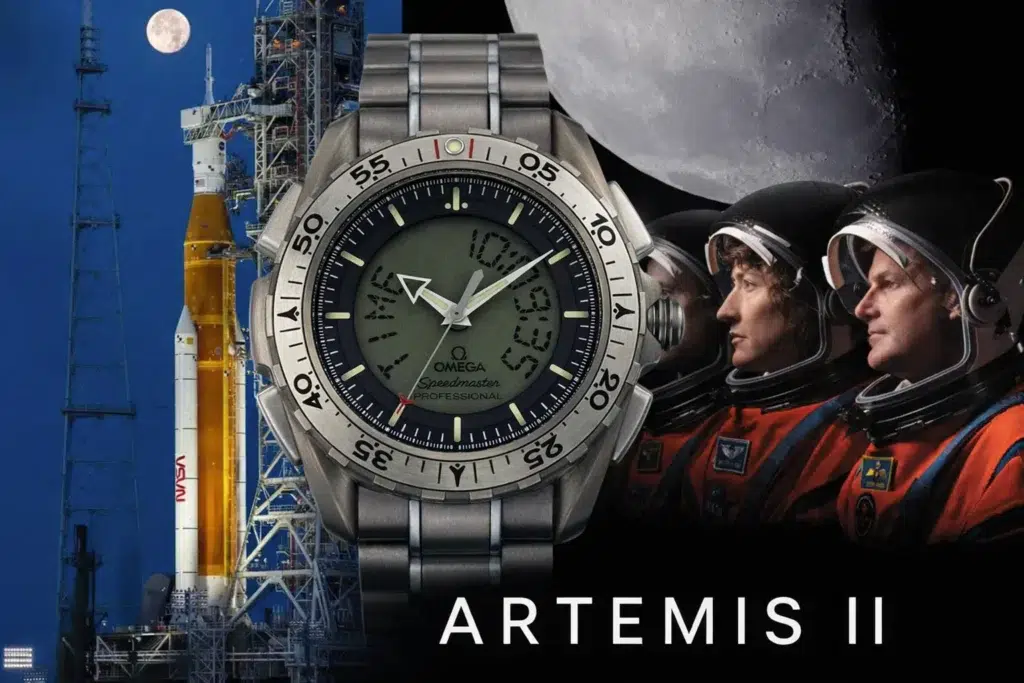
Then you get to the part that really matters. This is a watch whose functions were designed with NASA and ESA test pilots, not with lifestyle marketers. It literally has “Mission Elapsed Time” built in because someone in a flight suit said, “We need that on the wrist.” Nobody ran a focus group to ask whether influencers would like the font. They asked people who routinely put explosive rockets between themselves and our blue planet what they needed, and then built exactly that. At this point, you can feel the conversation either click or die. Most people still do not understand a flying fuck why any of this is important. They see a slightly nerdy, digital Omega; I see a certified piece of space mission equipment. They see a quirky forty-year-old quartz watch; I see a handshake between traditional watchmaking and applied rocket science. And now, with Artemis II on its way and those same instruments strapped to real astronaut wrists, that little piece of madness on my arm is finally doing exactly what it was born to do: reminding me that even if I never made it into the cockpit, I am still, in my own small way, orbit‑adjacent.

My watch… is going to the Moon
Right now, as you read this, there is a crew out there on Artemis II, the first crewed mission of NASA’s Artemis program that is actually going back to the Moon instead of just circling our own planet. Artemis II is the dress rehearsal for humanity’s return to the lunar surface: a multi‑day journey that takes a crewed spacecraft out of low Earth orbit, sling it around the Moon, and bring it safely home, proving that all the systems, humans included, can handle the 400,000‑kilometer round trip. Finally the bridge between Apollo and the future; the mission that turns “we could go back one day” into “we are going back, now,” with all the engineering courage and political stubbornness that implies.
The people on board are not just doing a few casual laps at 400 kilometers altitude, gently floating around and filming zero‑G snack tricks for social media. They are strapping themselves to a skyscraper filled with highly disciplined explosive chemistry, pointing that controlled insanity at the Moon, and collectively deciding that this is a perfectly acceptable way to spend the next ten days of their lives. They are literally leaving the comforting shell of low Earth orbit and heading into deep space, in a trajectory that only a handful of humans have experienced before.
On their wrists, as they do this, are Omega X‑33 watches, purpose‑built instruments designed to help them track mission phases, alarms, and elapsed time in an environment where timing is not a detail but survival. On my wrist, as I sit here on a perfectly unmoving chair on a perfectly stationary piece of Earth, there is also an Omega X‑33 quietly ticking away. Theirs is riding a rocket; mine is riding a pulse. You can see where I am going with this: my watch is quite literally going to the Moon with them, and in some small, irrational, but very satisfying way, that means a little part of me is hitching a ride too.
Astronaut by proxy
Let’s do the math: Astronauts going 400,000 km wear an X‑33. I wear an X‑33. Therefore, by the ancient, indisputable and noble laws of horological logic: I am, at the very least, one tiny fraction of an astronaut.
No, I’m not in the capsule. I’m not seeing the curvature of the Earth through a tiny window, or feeling my stomach float as gravity politely lets go. My colorblindness still means nobody is going to let me anywhere near a launch checklist. But when that crew checks MET, or syncs a phase of their mission, or glances at their wrist in that quiet second between “Ignition” and “Oh, shit, we’re really doing this” , the instrument they look at is a cousin of the one quietly ticking away on my arm.
The same red seconds hand, the same shrill alarms, the same unapologetically nerdy, aggressively functional, utterly un‑fashion‑influencer piece of hardware. They’re strapped into a moon rocket, I’m strapped into a desk chair. For a tiny, irrational, delicious sliver of my brain, that’s close enough.
The kid who made it
I still remember sixteen‑year‑old me walking out of that eye doctor’s office, feeling like someone had quietly deleted the future and replaced it with a slightly blurry placeholder. Back then, colorblindness felt like a cosmic joke. Now, I’ve made peace with it. I won’t plant a flag in lunar dust, I won’t float through an Orion capsule, watching the Earth shrink to a marble. The closest I’ll get to Mission Control is a livestream and a cup of coffee.
But on my wrist, there is something small, precise, and completely insane that says: “You didn’t make it to the astronaut corps. But you never really let go, did you?” He’s right, that little titanium bastard. I didn’t. So when Artemis lit up the night and the crew rode that column of fire out of our gravity well, I was watching the launch… and I glanced at my X‑33.
Somewhere in me a kid who wanted to be an astronaut smiled and thought: “Fine. You wouldn’t take me to the Moon. So I sent my watch instead.”