To cat or not to cat: open the damn box.
Cats, as everyone on this side of Uranus knows, make terrible consultants. Ask someone who has ever lived with one: you get a long, unblinking, disdainful stare, a strong impression that you have disappointed them, a hairball on the final deliverable, and an invoice in the form of an almost dead mouse on the doormat.
Two of them, however, have been running a remarkable and highly profitable share of Western AI strategy for the last three years. They don’t appear in the org chart (that is a smart consultant move). They never attend the steering committee. Their pawprints are on a plethora of decisions, including the CFO’s.
One sits grinning in a tree, cheerfully and totally unbothered about where you are going. The other sits in a sealed box that company policy forbids anyone from opening. Both were invented by extremely clever men to make a very precise and philosophical point. Both have since been hired by people who threw away the point and the philosophy altogether, and kept the cat.
The grin in the tree
Lewis Carroll’s slightly creepy Cheshire Cat has been grinning at lost people since 1865. In Chapter VI of Alice’s Adventures in Wonderland, Alice arrives at a fork in the road, finds the Cat lounging in a tree, and asks for directions, as one does:
“Would you tell me, please, which way I ought to go from here?”
“That depends a good deal on where you want to get to,” said the Cat.
“I don’t much care where…” said Alice.
“Then it doesn’t matter which way you go,” said the Cat.
“…so long as I get somewhere,” Alice added as an explanation.
“Oh, you’re sure to do that,” said the Cat, “if you only walk long enough.”
I have quarreled with this animal before, so I’ll spare you the full sermon. The Cat’s advice is impeccable, cruel, smart, viciously obvious. It hangs on a destination, and Alice refuses to name one, because she does not have any. What fascinates me these days is the next scene, the very one Carroll (writing in tempore non suspecto, long before AI) never wrote. Alice has accepted the deal. She is, like that famous Johnnie Walker, still walking. Because she has absolutely no idea where she’s going, she has no way of measuring progress.
So she measures the walking.
Corporate life has turned this into an HR process. In April 2025, Shopify’s CEO Tobi Lütke posted on X the memo he had sent his staff, under the extremely motivating title “AI usage is now a baseline expectation.” The line everybody screenshotted: “Before asking for more Headcount and resources, teams must demonstrate why they cannot get what they want done using AI”. AI usage questions would go into the performance and peer review questionnaire, because “learning to prompt and load context is important, and getting peers to provide feedback on how this is going will be valuable”.
Credit where it’s due, and I mean that. Lütke wrote it down, signed it, shared it, and included himself in the experiment. (“This applies to all of us, including me and the executive team”). Plenty of companies run exactly the same policy with no signature, no memo, and a lot of meaningful looks in the corridor. Telling people to go and play with a powerful new tool is hardly a war crime.
But look at what ended up on the review form. Did you use AI? Why? Did you prompt it well? Did your colleagues watch you do it? That is a Fitbit for the soul. A pedometer is the one management instrument that works perfectly without a destination, which may explain why it has become so fashionable. You can’t grade anybody on getting closer to where the company wants to be if the company has never said where that is. There is no strategy. No lighthouse, no vision, no beaming beacon. You can count steps, though. That’s easy. Steps go green on a dashboard. Dashboards go into board packs. Boards like green.
Somebody, surely, gets a bonus for the dashboard.
I can hear the objection, and it’s a good one (for once): nobody knows the destination yet, and wandering is how you find out. You walk, you see things, you experience stuff, you discover. Agreed. Some of the best things AI will do for companies haven’t been imagined, and the people who stumble onto them will probably be the ones who wandered off the path. But explorers, real ones, keep a log. Where the ground gave way, which river turned out to be a swamp, what they found on the far side of the hill. A logbook records experiences, encounters and arrivals. A step counter records your enthusiasm for footwear and pointless exercise.
Then there’s the headcount line, the bit that launched a thousand (ChatGPT-written) LinkedIn sermons. Before you hire a human, prove the machine can’t do it. For one hire, on one team, fair enough. As standing policy, it quietly answers a much bigger question: should a person do this work? Default answer: no, until somebody proves otherwise. That is about as large a decision on where a company is going as you can make. Oh hell, what fresh, steaming, industrial-grade horse manure has just crawled out of the universe’s sweaty backside? And it arrived in a memo about tools, filed under productivity, which is exactly where a Cheshire strategy likes to keep its big decisions. Somewhere nobody will ever even think to look.
Pardon the expression
So Alice walks. Still walking. Eventually somebody, usually the one who hasn’t yet learned to keep quiet, asks the awkward question. What is all this walking doing?
Cue the second cat.
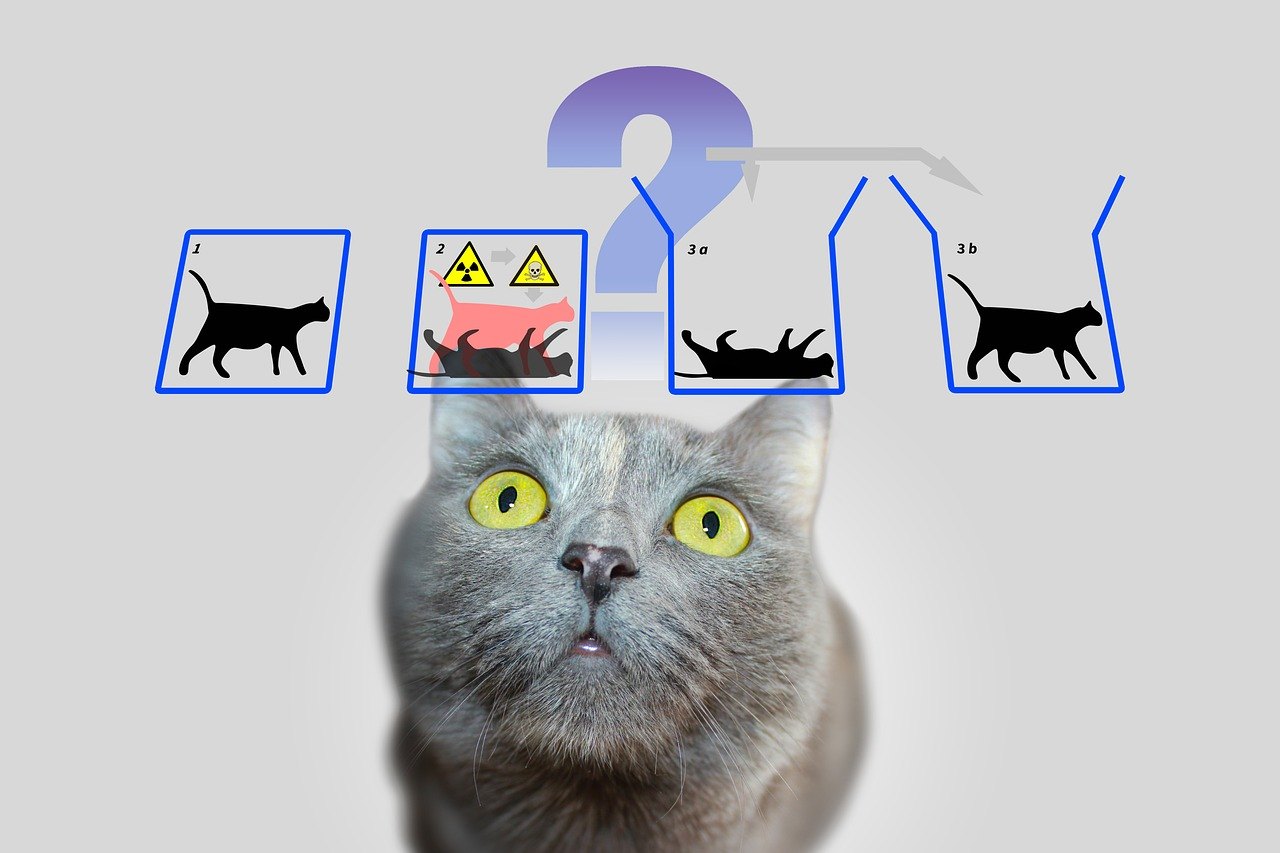
In 1935 the Austrian physicist Erwin Schrödinger described a thought experiment that now decorates an alarming number of coffee mugs and cheap questionable T-shirts. A cat goes into a sealed chamber (a box, really) with a speck of radioactive material, a Geiger counter and a small vial of very potent poison. If an atom decays, the vial breaks and the cat dies. Apply the quantum description of that atom to everything in the box and you end up, in the translation quoted by Britannica, with “the living and dead cat (pardon the expression) mixed or smeared out in equal parts.” Mjammie.
The people quoting him on conference stages most conveniently tend to skip the next bit. Not me, here goes: Schrödinger thought the whole thing was “quite ridiculous”. He built the box as a reductio: if your reasoning ends with a cat that is both alive and dead, your reasoning has gone very, very wrong somewhere. As far as he was concerned, out here among objects you can trip over at night, the cat is one or the other, and your not looking does nothing whatsoever for its health.
Executives use him exactly backwards.
What will AI do to jobs? Too early to tell. To juniors? Too early to tell. To the call center in Charleroi, to the clerk who used to catch the errors, to a kid who has never written a paragraph without something finishing it for her? Too early to tell, deserving of further study, and frankly a complex societal question well above the pay grade of a humble software buyer. The cat is in a superposition, you see. It would be irresponsible to speculate.
Curiously, the cat is very much alive in the investor deck, where the productivity gains have been booked to two decimal places. Its other state appears in no document. Schrödinger wrote a joke about bad reasoning. We turned it into a governance framework.
The box stays shut, because opening it is always somebody else’s job. The OECD’s Digital Government Outlook 2026 reports that 35 of 36 OECD countries use AI in at least one area of government. Six report measuring how their use of AI affects society. Six. You could shoehorn them into one Brussels taxi (they’d still be stuck on the Ring, but they’d be in it together).
Thirty-five governments put the cat in the box. Six had a look.
Somebody opened one
The awkward thing for Schrödinger’s corporate fan club is that boxes open. You don’t need a particle accelerator. Usually some nerve will do. On October 16, Anthropic published a report on its own workforce, built from its internal employment, hiring and productivity data plus interviews with 17 employees. Juniors’ share of its technical hires fell from 27% to 9%; juniors’ share of technical staff fell from 21% to 14% since early 2025. Technical hiring still grew in absolute numbers, so these are shares, from one unusually AI-soaked company describing itself. It proves nothing about your sector, and I have grumbled about the vanishing junior rung before.
The numbers interest me less than the gesture. A company that sells the technology lifted the lid on its own box and published what it saw. You are welcome to raise an eyebrow at the motive (an AI lab announcing that AI has thoroughly rewired it is hardly bad for the sales pitch; it’s a bit like a gym publishing its own personal trainers’ abs). Still. It looked. Meanwhile plenty of its customers stand solemnly next to their own boxes, explaining to anyone who’ll listen that the contents are fundamentally unknowable.
They aren’t. The answers are sitting in the HR system, two floors down. Who did we stop hiring this year? Which tasks moved to the machine, and who used to learn the trade doing them? How long does it now take a customer with a weird problem to reach a human who is allowed to fix it? None of that needs a forecast or a futurist. It needs somebody with the authority to open the lid and the stomach to read the result out loud, in the same meeting where the savings get announced. Is the cat dead? Alive?
Same client, two invoices
Put the two cats side by side and something rather elegant appears. They work for the same person. On Monday the client needs Cheshire. The future is coming, the competition is moving, any road will do as long as we walk fast, and look, the dashboard says we are walking very fast indeed. On Thursday somebody asks what the walking costs, and the client needs Schrödinger. Too early to tell. Complex. Further study. The same executive is a visionary about the upside and a devout agnostic about the side effects, and both cats bill by the hour.
I would love to say I watch all this from a safe distance. I don’t. I’m a futurist, which is a job where people pay you to stand in front of a very large screen and describe the contents of boxes nobody has opened. Madame Soleil with a clicker. I use AI every day, and I know exactly how fast a tool that saves me an hour stops being asked what else it’s doing to me (about a week, if I’m tired). Give me a nice grin and a closed box and I can rationalize with the best of them.
The cats are excellent company. That’s the problem.
None of this is a plea to walk slower. Walk. Wander, experiment, get gloriously lost. I want the machines that let a small team look after customers it used to ignore, and the ones that help a child attempt harder things while staying curious. But keep a log of where the walking took you. And open the damn box, regularly, while you can still change the route.
If you want a role model, skip both of the famous ones and get an ordinary cat. Anyone who has lived with one knows they have never believed in superposition for a second. Whatever happened out there in the night, a real cat brings the result home and leaves it on the doormat, where you will find it at seven in the morning, in your socks, on your way to the steering committee. Unrequested. Unambiguous. Impossible to file under further study.
Of all the cats in this story, it’s the only consultant worth the fee.